Swipe Left on the Algorithm: Black Expats in Tokyo Are Done Playing by Someone Else's Rules
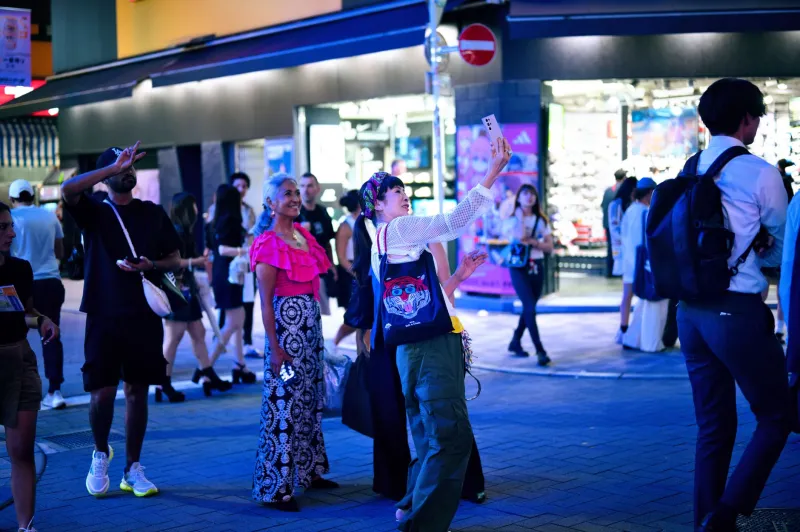
Let's be honest about something most dating app think pieces won't say out loud: the algorithm was never neutral. It was never some colorblind cupid floating in the cloud, just trying to find your person. For Black users — especially Black users operating in a country where they're already navigating layers of visibility and invisibility — apps like Tinder, Bumble, and Pairs became something closer to a funhouse mirror. Distorted. Sometimes dehumanizing. And exhausting in a way that's hard to explain to someone who hasn't lived it.
Talk to enough Black expats in Tokyo and a pattern emerges fast. The matches that come through don't always feel like genuine connection — they feel like a category has been selected. The DMs arrive with a kind of enthusiasm that has nothing to do with you and everything to do with what someone decided Black people represent. And then there's the flip side: the quiet disappearances, the unmatches after a photo swap, the eerie silence that follows when you suspect — but can never prove — that your race became a dealbreaker the moment your face loaded on someone's screen.
The Fetish Is Not a Compliment
One of the first things Tokyo-based expats will tell you about the dating app experience here is that fetishization and racism aren't opposites. They're cousins. Being hypersexualized isn't the same as being desired — not in any real, human sense of the word. And yet that distinction gets blurred constantly in online dating spaces, especially when you're a Black person in a city where the cultural imagination around Blackness has been heavily shaped by American pop exports and very little else.
Black women in Tokyo describe opening their match queues to find messages that lead with their race before their name. Black men describe being treated like an experience to collect rather than a person to know. Both describe the particular fatigue of having to decide, in real time, whether to engage or block, to educate or exit the conversation entirely. And all of this is happening while they're also navigating work, community, language barriers, and the general emotional labor of expat life.
Meanwhile, research has consistently shown that Black users receive fewer matches and less engagement on mainstream dating platforms across the board — a disparity that compounds when you're already a minority within a minority. Tokyo's Black community is tight-knit and resilient, but it's not large. The math on these apps was never in anyone's favor.
When the Platform Won't Fix Itself, You Build Your Own
So people started building. Not in the dramatic, press-release kind of way. More quietly. More community-first.
What's emerged in Tokyo's Black expat scene over the last few years isn't a single app with venture funding and a launch party. It's a constellation of solutions — some digital, some deeply analog — designed to fill the gap that Tinder never bothered to close. Private Instagram groups functioning as soft matchmaking spaces. WhatsApp threads where someone will casually mention that a friend just moved to the city and is looking to meet people. Curated events — dinners, gallery nights, rooftop hangs — designed explicitly to create the kind of low-stakes, real-world connection that swiping never quite delivers.
Some folks in the community have gone further, prototyping actual platforms. The conversations happening in Tokyo's Black expat circles about what a better dating app would look like are genuinely interesting — and they're not just about race-matching. They're about values alignment, about building spaces where users control their own visibility, where the filtering tools don't get weaponized, and where the community moderation is handled by people who actually understand what's at stake.
Think about what that means: Black expats in Japan, operating thousands of miles from home, are essentially doing the product design work that billion-dollar companies have refused to do. That's not just hustle. That's a form of self-determination.
Digital Spaces Are Cultural Spaces
Here's what gets lost when this conversation gets reduced to "dating app drama": the way we build romantic spaces reflects the way we think about belonging. Who gets to be desirable? Who gets to set the terms? Who gets protected when things go wrong?
For Black expats in Tokyo, those questions aren't abstract. They live inside every swipe, every match notification, every conversation that starts with a microaggression disguised as a compliment. The dating app experience is a microcosm of the broader experience of moving through spaces that weren't designed with you in mind — and deciding what to do about that.
Some people opt out entirely. They delete the apps, lean into their real-world networks, and let things happen organically. Others stay on the platforms but develop a kind of emotional armor — specific, practiced ways of screening early, redirecting conversations, exiting gracefully. And others are building, literally and figuratively, because they believe the infrastructure of connection matters and someone has to get it right.
The Deeper Conversation
What makes Tokyo's Black community interesting in this particular conversation is the global dimension. You've got people here from the US, from the UK, from West Africa, from the Caribbean, from Brazil — all bringing different frameworks for thinking about race, dating, and desirability. A Black American woman's experience on these apps isn't identical to a Nigerian man's experience, which isn't identical to a British-Jamaican person's experience. But there's enough overlap in the frustrations that the conversation becomes collective fast.
And that collectivity is, genuinely, the most powerful thing happening here. Not the apps. Not the algorithms. The fact that people are talking — loudly, honestly, across backgrounds — about what they deserve from digital spaces and from each other. The fact that the answer to a broken system isn't just complaining about it but actually imagining something different.
That's very Black. That's very Tokyo. That's very us.
The algorithm didn't build this community. The algorithm couldn't. But the community is building something the algorithm never could — and that might be the whole point.