Building the Village: How Black Families in Tokyo Are Creating Schools Within Schools
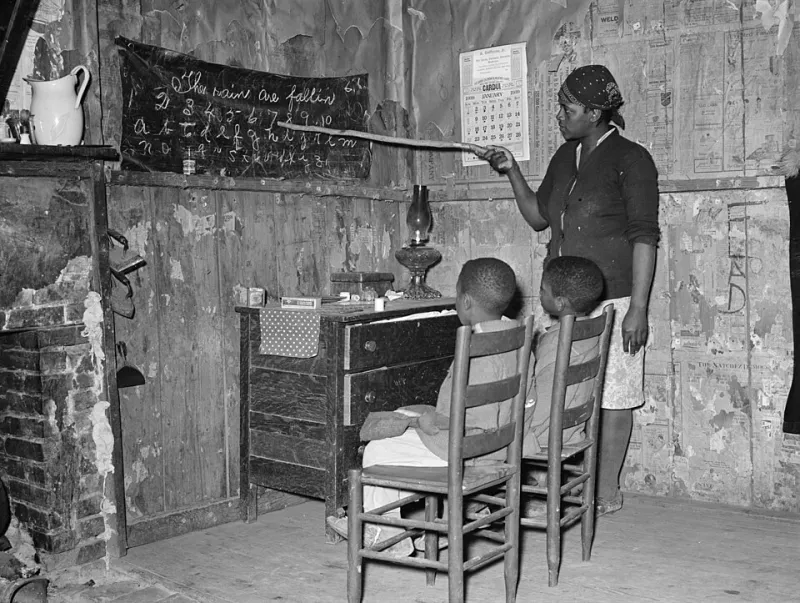
Photo: Russell Lee, Public domain, via Wikimedia Commons
In a second-floor community room above a jazz bar in Nakameguro, about a dozen kids are gathered around folding tables on a Saturday afternoon. Some are working through math problems. Others are deep in a discussion about the Harlem Renaissance. One corner of the room has turned into an impromptu debate about whether Kendrick Lamar is the greatest lyricist of his generation. The adult facilitating all of this — a Ghanaian-American software engineer named Kofi — keeps the energy moving with the easy authority of someone who's been doing this for years.
This is not a school. There's no accreditation, no official curriculum, no government funding. What it is, though, might be more important: it's a community holding itself accountable for its children's futures.
Across Tokyo, Black families — American, African, Caribbean, and from every point of the diaspora in between — are quietly building these kinds of spaces. Informal but intentional. Grassroots but rigorous. They're filling gaps that neither Japan's education system nor international schools were designed to address, and in the process, they're creating something that looks a lot like the village the old folks always said it takes.
The Gap That Nobody Talks About
Japan's public school system is, by many metrics, excellent. High literacy rates, strong math outcomes, a culture of discipline and collective responsibility that produces genuinely impressive results. But it was built for Japanese children, in Japanese, with Japanese cultural frameworks at the center. For Black kids growing up in Tokyo — whether they were born here or arrived mid-childhood — that system can feel like wearing shoes that are two sizes too small.
International schools offer an alternative, but they come with a price tag that puts them out of reach for many families, and even within those schools, the curriculum is typically designed around a Western (read: white Western) canon. A Black child in an international school in Tokyo can go an entire academic year without encountering a single text by a Black author, a single historical figure who looks like them, a single lesson that affirms their specific experience of the world.
"My daughter came home one day and asked me why Black people weren't in her history books," recalls Simone, a 40-year-old mother from Baltimore who's been in Tokyo for eight years. "She wasn't being dramatic. She genuinely didn't see herself anywhere in what she was being taught. That was the moment I knew we had to do something ourselves."
That something became a monthly study circle that now draws fifteen to twenty kids and their parents every other weekend. They read Baldwin and Octavia Butler. They study the African kingdoms that predated European colonization. They talk about code-switching and identity and what it means to be Black in a country where Blackness is simultaneously hyper-visible and culturally misunderstood.
The Architecture of an Alternative
What's remarkable about these educational networks is how organically they've evolved. Nobody sat down and wrote a strategic plan. They grew out of necessity, out of group chats and barbecue conversations and the shared recognition that waiting for institutions to catch up wasn't a viable parenting strategy.
The structures vary. Some families have organized formal tutoring cooperatives where parents rotate teaching responsibilities based on their professional expertise — an accountant teaches financial literacy, a nurse runs health and science sessions, a musician leads music history. Others have built mentorship pipelines connecting Black teenagers in Tokyo with Black professionals across industries, using video calls to bridge the gap when in-person isn't possible.
There are also cultural schooling initiatives that focus less on academic content and more on identity formation. These programs borrow from the tradition of Freedom Schools that emerged during the Civil Rights Movement — spaces explicitly designed to affirm Black dignity and possibility in the face of systems that denied both.
Dre, a 44-year-old from Atlanta who runs a youth leadership initiative out of his apartment in Minato, describes his program's philosophy simply: "I want these kids to leave every session knowing that they come from greatness. Not as an abstract concept — as a lived reality backed up by history, by art, by science, by everything their ancestors built. That's the foundation. Everything else — the skills, the networks, the opportunities — gets built on top of that."
The Students Themselves
The kids navigating these dual educational lives are doing something genuinely extraordinary, even if they wouldn't use that word for it. They're operating across multiple cultural frameworks simultaneously — Japanese school culture during the week, diasporic community culture on weekends, American or African family culture at home. It's a cognitive and emotional load that most adults would find challenging.
But many of them are thriving in ways that are directly attributable to the community support structures around them. They're bilingual or trilingual. They have a sophisticated, early-developed understanding of identity and power. They move between worlds with a fluency that their peers — in Japan and back in the US — often lack.
Jaylen, a 16-year-old whose mother is from Detroit and whose father is Nigerian, has been part of Tokyo's Black educational community his whole life. He's applying to colleges in the US next year and credits his community learning experiences as much as his formal schooling for preparing him.
"In regular school, I'm learning how to pass tests," he says with the kind of clarity that stops you in your tracks. "In community, I'm learning who I am. You need both. But honestly, if I had to choose, I know which one matters more."
What This Looks Like Going Forward
The movement — and at this point, it's fair to call it that — is starting to develop more formal connective tissue. WhatsApp groups have evolved into organized networks. Annual gatherings are becoming regular programming. Some participants are exploring whether they can establish more permanent institutional structures, though most are wary of the bureaucratic weight that comes with formalization.
The deeper aspiration, though, isn't institutional. It's generational. The parents building these spaces today are thinking about the kids who will grow up in them — who will carry this model with them when they eventually leave Tokyo and land somewhere new, and who will know, instinctively, that when the village doesn't exist, you build it.
Back in that room in Nakameguro, the Kendrick debate has been resolved — or at least tabled. Kofi is wrapping up the session, asking each kid to name one thing they learned and one question they're leaving with. The answers are thoughtful. The questions are even better.
This is what investment looks like. Not a line item in a budget. A room full of children who know their names mean something.